
August 20, 2026
How to build an Agent-friendly website
Agents such as Claude Code, Cursor, and Codex already look up documentation, call APIs, and write code directly. Humans are no longer the only readers of developer tool documentation.
However, a website that provides a great experience for humans may still be difficult for Agents to use:
- Humans can browse through navigation, while Agents may not know where to start;
- Humans see a fully rendered page, while Agents may receive only an empty shell waiting for JavaScript to run;
- Humans can ignore navigation, buttons, and ads, while Agents must extract the main content from a large amount of HTML;
- Even if a website provides Markdown, Agents may not know it exists.
Rspress is a static site generator built on Rsbuild. It aims to make every document easier for Agents to discover, read, and understand. This article introduces Rspress's Agent-friendly best practices.
llms.txt: A sitemap for the agent era
The llms.txt specification defines a Markdown index file placed at the root or a subpath of a website. It contains an introduction to the website and links to detailed content.
sitemap.xml helps search engines index pages; llms.txt helps Agents discover content through progressive disclosure: it first provides a concise documentation index, then lets Agents read relevant pages on demand.
For example, the Rspress website's llms.txt file is available at https://rspress.rs/llms.txt:
Rspress's current doc_build output falls into three categories: HTML for humans, per-page Markdown for Agents, and index files for content discovery.
SSG-MD: The Markdown version of SSG
Rspress provides Static Site Generation to Markdown (SSG-MD). Similar to Static Site Generation (SSG), SSG-MD renders pages as Markdown files instead of HTML files and generates llms.txt and llms-full.txt, making technical documentation easier for large language models to understand and use.
Rspress is not only an SSG framework; it also treats Markdown generation as a first-class capability through SSG-MD: HTML for humans, Markdown for AI.
The following table compares SSG and SSG-MD:
Why SSG-MD?
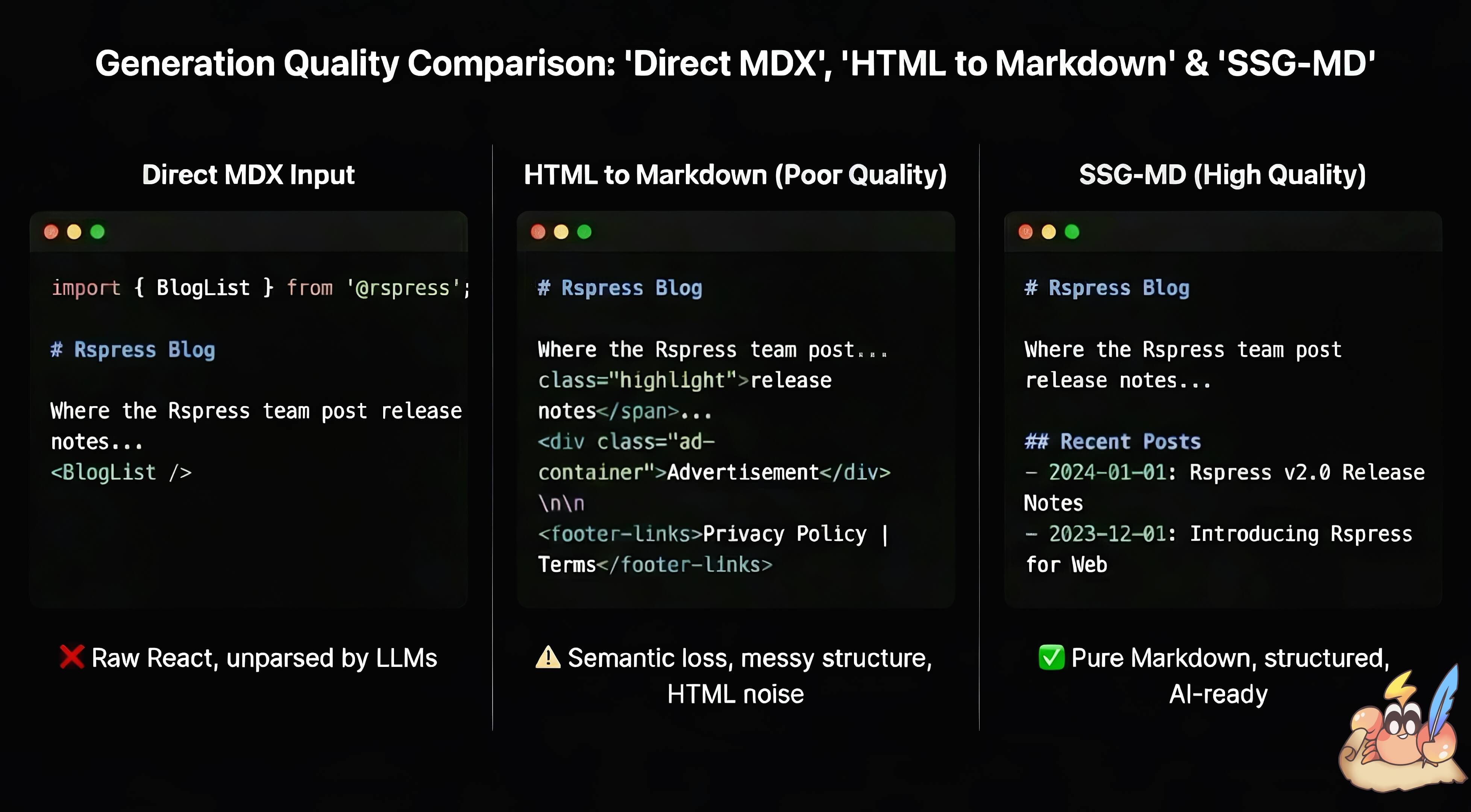
In React-based frontend frameworks, extracting static information from dynamically rendered content is often difficult. MDX has the same challenge: .mdx files contain Markdown content but can also embed React components, making docs more interactive. Rspress lets users enhance docs with MDX fragments, React components, Hooks, and TSX routes, but this dynamic content creates problems when converted to Markdown:
-
Feeding raw MDX to AI introduces code syntax noise and loses rendered React component content.
-
Converting HTML to Markdown often produces poor results, making information quality hard to guarantee.
Static Site Generation (SSG) generates static HTML for crawlers and improves SEO. SSG-MD addresses a similar problem for AI tools: it improves GEO and the quality of static information for large language models. Compared with HTML-to-Markdown conversion, rendering from React's virtual DOM gives SSG-MD a richer information source.
How does SSG-MD work?
- Rspress internally implements a
renderToMarkdownStringmethod similar torenderToStringinreact-dom, which renders React components to Markdown strings:
In principle, this API works for any site built with React; see react-render-to-markdown if you're interested.
- Rspress uses a custom remark plugin,
remarkSplitMdx, to preprocess MDX files before rendering. This plugin splits the MDX AST, separating pure Markdown content from JSX components: Markdown text is serialized as string literals, while JSX components and MDX expressions (for example,{variable}) are preserved as React elements. This ensures that Markdown content passes through as-is without being processed by React rendering, while dynamic components are rendered byrenderToMarkdownString.
For example, the following MDX:
is transformed into a component like this:
- Rspress provides the
import.meta.env.SSG_MDenvironment variable so React components can distinguish SSG-MD rendering from browser rendering and customize their output:
- Rspress's internal component library is adapted for SSG-MD, so components render meaningful Markdown during the SSG-MD phase. For example:
It is rendered as:
Accept: text/markdown: Return Markdown based on the request header
In November 2025, Claude Code lead Boris Cherny wrote on X:
In the next version of Claude Code, Claude’s WebFetch tool automatically adds Accept: “text/markdown, *” to requests which helps docs sites provide token-efficient docs.
Cloudflare has also observed that coding Agents such as Claude Code and OpenCode send an Accept request header containing text/markdown.
Agent clients such as Claude Code and documentation sites such as Bun were among the first to adopt the Accept: text/markdown convention. Compared with HTML, Markdown excludes page chrome such as navigation, styles, and scripts, uses less context, and eliminates the need to extract the main content from HTML. Agents can therefore obtain usable content more quickly. If a website already produces Markdown, supporting this request header makes these benefits reliable instead of depending on each client to parse HTML itself.
Rspress is a purely static framework and has no deployment server that selects HTML or Markdown based on the request header. Supporting the header is still straightforward: configure a rule on the hosting provider. The Rspress website uses a Cloudflare rewrite. Requests containing Accept: text/markdown are internally rewritten to the corresponding .md file at the same path, while regular browsers still receive HTML from the same URL.
The response is Markdown:
AFDocs: Checks and scoring
AFDocs is the companion open-source tool for the Agent-Friendly Documentation Spec. Its checks reference lists 23 checks across 7 categories, together with the pass, warning, and failure criteria for each check.
Several Rspress Agent-friendly optimizations described in this article can be validated through AFDocs checks:
Rspress also uses other AFDocs checks to guide further improvements, including metrics such as HTML size.
Run the following command to check a public documentation site:
The report includes the result of each check, suggested changes, and a score, making it useful for comparing the site before and after an Agent-friendly update.
Mintlify's Agent Score is also based on this specification. In addition to the 23 baseline checks, it adds discoverability checks for full content, Agent Skills, and MCP Servers.
Notably, AFDocs does not evaluate writing quality or the correctness of Agent answers. It only checks a set of verifiable rules.
injectLlmsHint: Expose the llms.txt URL
AFDocs Content Discoverability checks include two relevant rules:
llms-txt-directive-html: When an Agent directly visits an HTML page, can it discover that the site hasllms.txtand a Markdown version of the current page?llms-txt-directive-md: When an Agent receives a Markdown page, can it discover where to find the entire documentation site?
Even when a website provides Markdown, an Agent entering through a deeply nested page may not know that the current page has a Markdown version or that /llms.txt exists. Each page therefore needs to expose these entry points explicitly.
Rspress enables injectLlmsHint by default. When SSG-MD is enabled, Rspress injects visually hidden plain text near the beginning of the main content in generated HTML:
This does not use display: none, hidden, or aria-hidden. The URLs also appear directly in plain text instead of being nested in link elements. The hint remains invisible to readers but stays in the DOM, allowing Agents that parse HTML or convert HTML to Markdown to preserve and read the directive.
The AFDocs llms-txt-directive-html rule emphasizes the same requirement: a directive can be visually hidden with techniques such as clip-rect or sr-only, but it must remain in the DOM and survive HTML-to-Markdown conversion.
The generated Markdown output also includes the following content:
The two outputs correspond to llms-txt-directive-html and llms-txt-directive-md.