
January 30, 2026
Announcing Rspress 2.0
We are excited to announce the official release of Rspress 2.0!
Rspress is a static site generator built on Rsbuild, designed as a documentation site tool for developers. Since its initial release in 2023, Rspress 1.x has gone through 144 releases, with 125 contributors participating in the project. More and more developers have chosen Rspress for its fast compilation performance, convention-based routing, and component library previews to build beautiful and reliable documentation sites.
Based on community feedback, Rspress 2.0 brings major improvements to theme aesthetics, AI-native, documentation development experience, integration with Rslib, and more.
Why Rspress 2.0
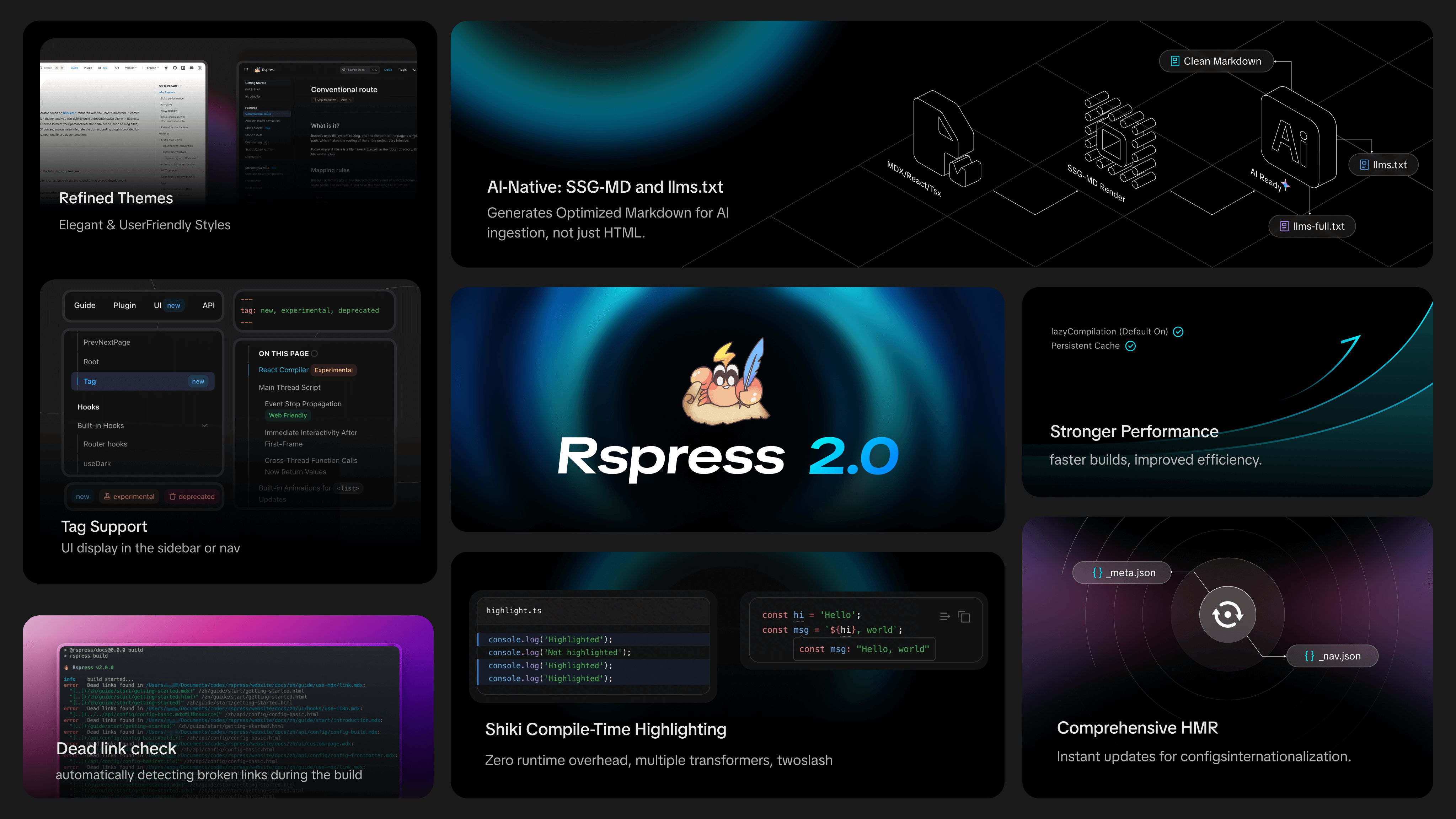
Rspress 1.x already solved the compilation performance problem for documentation site frameworks, but some other issues still affected the core experience as a documentation development tool. Version 2.0 goes beyond the pursuit of compilation performance and also focuses on other aspects of the documentation site experience:
-
Theme Styling: A more beautiful default theme, along with multiple custom theme approaches, addressing the lack of stable APIs for theme customization in 1.x.
-
AI-native: Documentation serves not only human readers but also needs to be better understood and used by Agents. Rspress now has built-in llms.txt generation and the SSG-MD capability derived from SSG, generating high-quality Markdown content for Agents to read.
-
lazyCompilation, Instant Startup: lazyCompilation is enabled by default, combined with resource prefetching on link hover, building only the required files when visiting specific routes, achieving instant startup regardless of project size.
-
Shiki Code Highlighting: Shiki is integrated by default, completing syntax highlighting at build time, with support for theme switching and transformer extensions like @rspress/plugin-twoslash, delivering richer code block display effects.
-
Documentation Development Experience: Optimized HMR for
_nav.json,_meta.jsonand other files, added json schema for IDE code hints; dead link checking enabled by default; new file code block syntax supporting external file references; @rspress/plugin-preview and @rspress/plugin-playground can now be used simultaneously. -
Rslib Integration: You can now select Rspress as the documentation tool when creating a component library project with
create-rslib, quickly setting up a component documentation site.
This is a comprehensive upgrade to the existing architecture. Below we introduce Rspress 2.0 and its brand new theme, high-quality llms.txt generation, Shiki integration, lazyCompilation, and other important features.
2.0 New features
Brand new theme
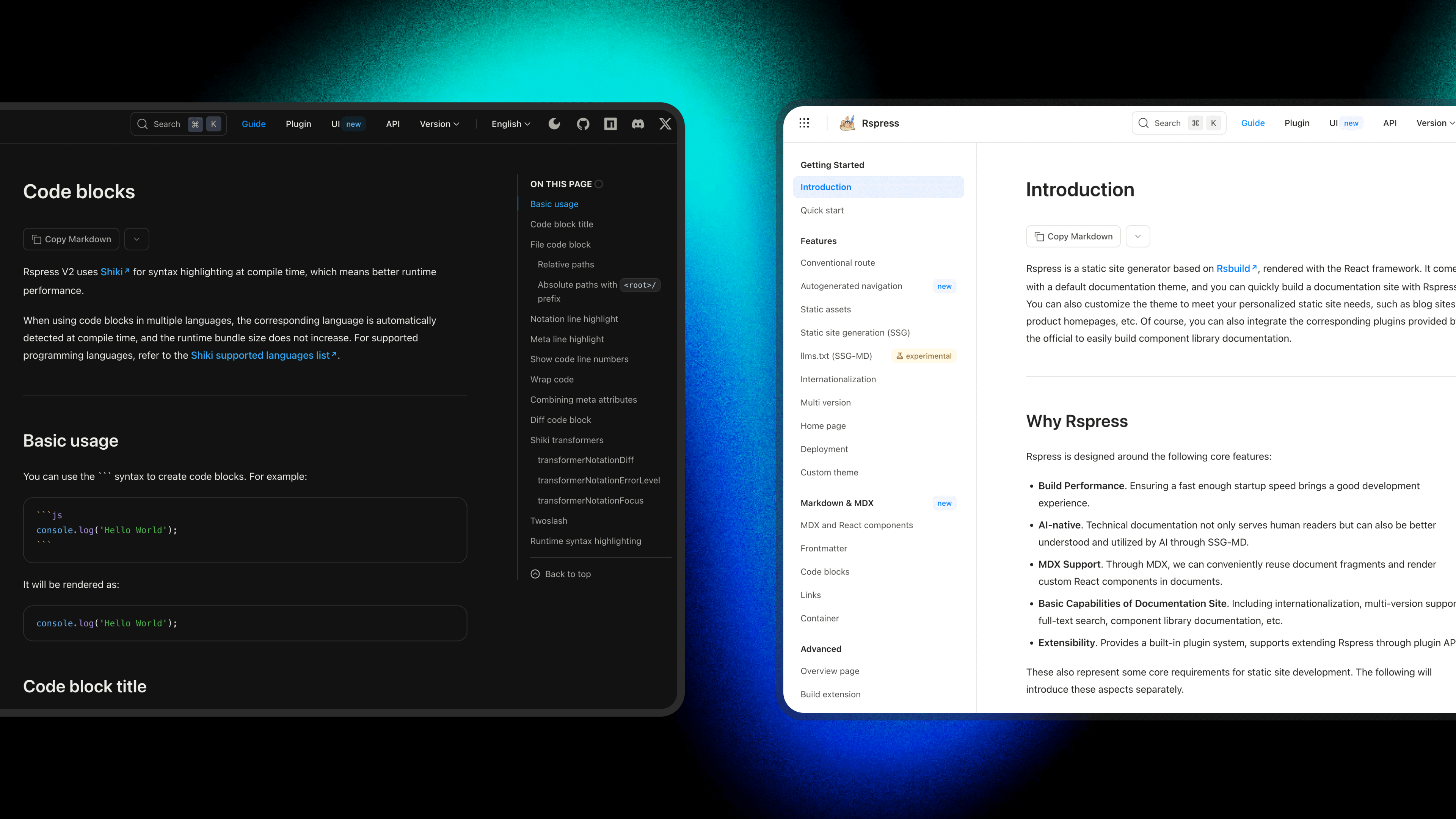
The 2.0 default theme has undergone a systematic upgrade, crafted by designer @Zovn Wei, with significant improvements in visual effects and reading experience. Each component is individually replaceable, providing high customizability.
Theme customization
From low to high levels of customization, there are four custom theme approaches: CSS variables, BEM class names, ESM re-export overrides, and component eject.
- CSS Variables: The new theme exposes more CSS variables, covering theme colors, code blocks, homepage styles, and more. You can interactively preview and adjust all CSS variables on the CSS Variables page, then copy the configuration directly into your project once you find a satisfying setup.
- BEM Class Names: All built-in components now adopt the BEM naming convention. This is an old-school choice, but also a well-considered decision. Users can precisely adjust styles through CSS selectors, with clearer HTML structure; at the same time, it decouples from any CSS framework the user may be using, allowing free choice of CSS frameworks (Tailwind, Less, Sass, etc.), such as using Tailwind V4 or V3 without worrying about version conflicts with Rspress's built-in CSS.
- ESM Re-export Overrides: If CSS modifications cannot meet your customization needs, you can perform deeper customization through JS. Using ESM re-exports in
theme/index.tsx, you can override any built-in Rspress component.
- Component Eject: You can use the new
rspress eject [component]command, which copies the source code of the specified component to thetheme/components/directory. You can freely modify this code, or even hand it to AI for modifications, to achieve deep customization.
Navbar and sidebar tags
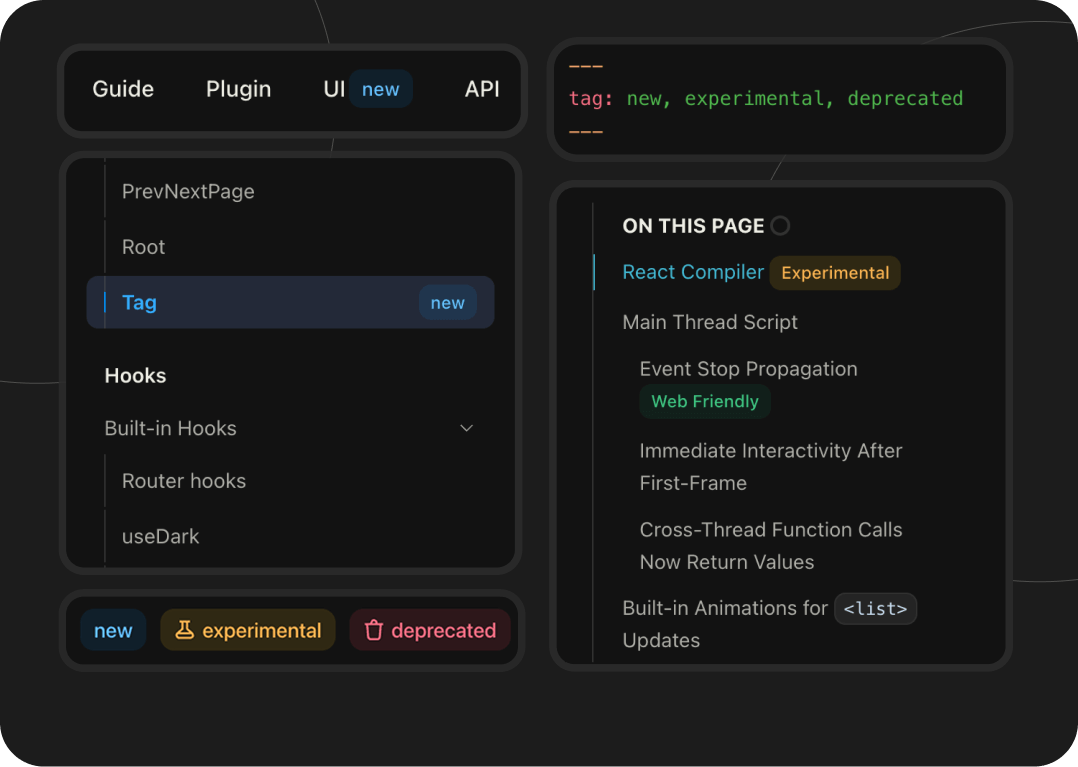
Rspress 2.0 implements a Tag component. You can now use the tag property in frontmatter to add UI annotations in the sidebar or navbar.
Built-in Multi-language Support
In version 1.x, Rspress included only English UI text. Using other languages such as zh required manually configuring every string, which was cumbersome. The 2.0 theme now includes built-in translations for zh, en, ja, ko, ru, and more languages. The system automatically tree-shakes translations based on language configuration and usage, bundling only the text and languages you use. Languages that are not built in fall back to en text. You can also extend or override translations through the i18nSource configuration option.
Rspress will add more built-in languages in the future. If you're interested, see this contributor's Pull Request.
llms.txt: SSG-MD for High-Quality Markdown content
Rspress now integrates llms.txt generation into core, and implements the new SSG-MD (Static Site Generation to Markdown) capability.
In React-based dynamic rendering frontend frameworks, extracting static information is often difficult, and Rspress faces the same challenge. Rspress allows users to enhance documentation expressiveness through MDX fragments, React components, Hooks, and TSX routes. However, this dynamic content faces the following issues when converting to Markdown text:
- Feeding MDX directly to AI includes a large amount of code syntax noise and loses React component content
- Converting HTML to Markdown often yields poor results with unreliable information quality
To solve this problem, Rspress 2.0 introduces the SSG-MD feature. This is a new capability, similar to Static Site Generation (SSG), but instead of rendering pages as HTML files, it renders them as Markdown files and generates llms.txt and llms-full.txt files.
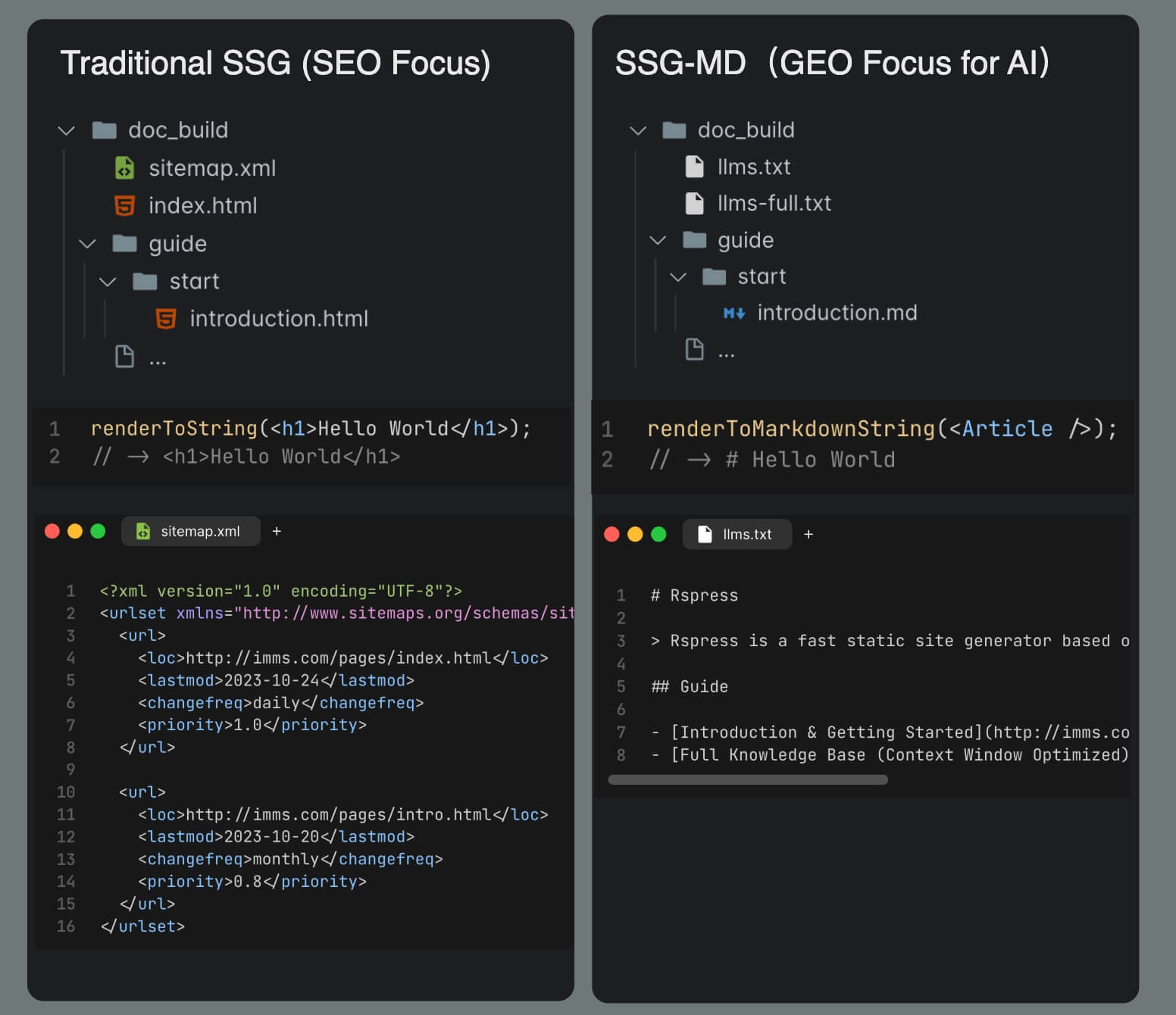
Compared to traditional approaches like converting HTML to Markdown, SSG-MD has access to richer information sources during rendering, such as the React virtual DOM, resulting in higher static information quality and flexibility.
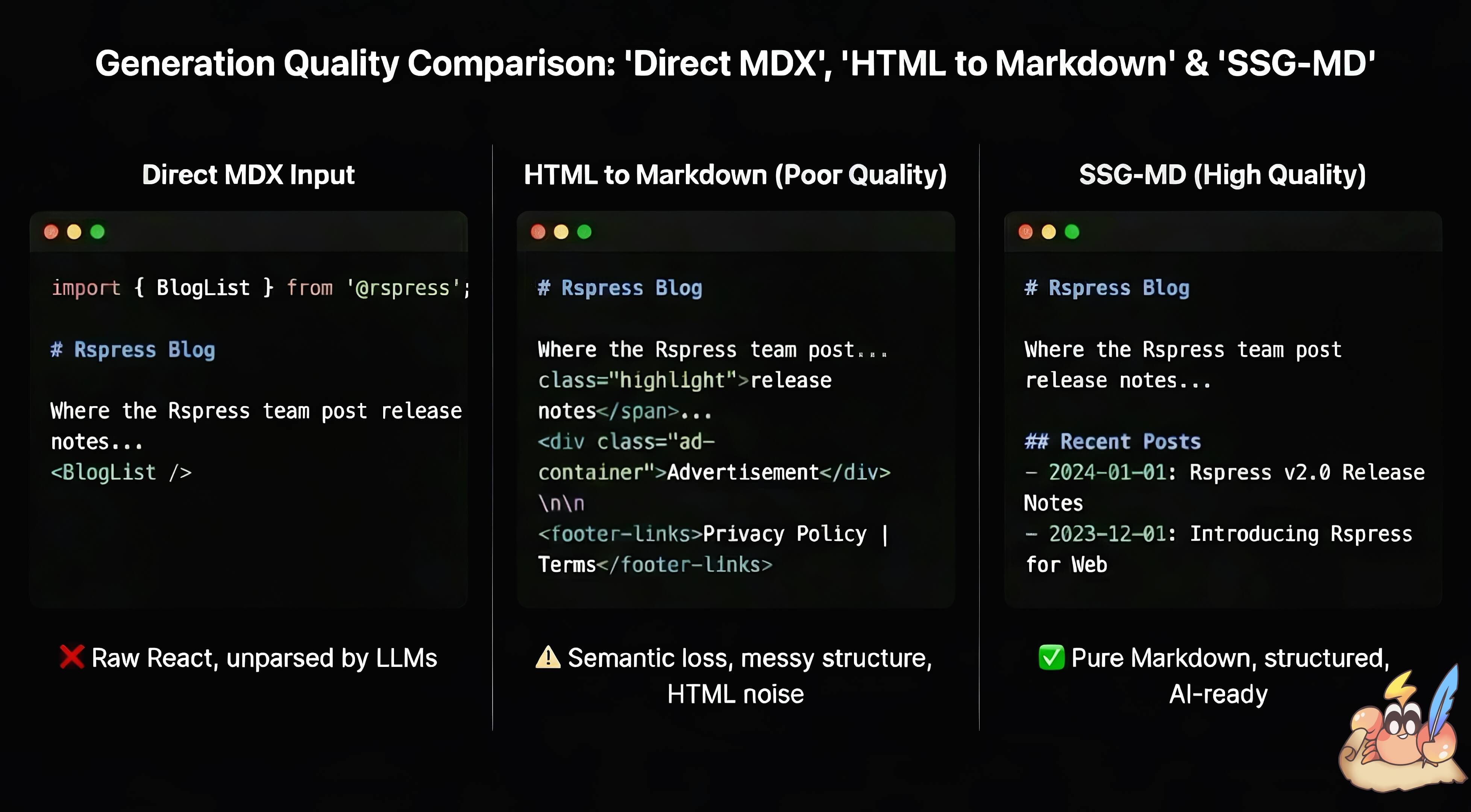
Enabling it is simple:
After the build, Rspress generates the following structure:
If you want to customize the rendering content in custom components, you can control it through environment variables:
This preserves the interactive documentation experience while helping AI understand the semantic information of components.
See SSG-MD Usage Guide for details
Shiki Build-time code block highlighting
Rspress 2.0 uses Shiki by default for code highlighting. Compared to the 1.x Prism runtime highlighting approach, Shiki performs highlighting at compile time.
- Supports multiple theme styles. You can interactively switch and preview different Shiki themes on the CSS Variables page.
- Shiki also allows extensions through custom transformers to enrich writing, such as twoslash.
- Programming languages are imported on demand, adding no runtime overhead or bundle size.
- Achieves accurate syntax highlighting consistent with VS Code based on TextMate grammar.
Here are some Shiki transformer examples to give you a feel for the documentation creativity Shiki enables:
Using @rspress/plugin-twoslash
Using transformerNotationFocus
See Code Blocks for details
Build Performance: lazyCompilation and persistent cache
Rspress 2.0 is powered by Rsbuild and Rspack 2.0 prerelease, with lazyCompilation and persistent cache enabled by default.
lazyCompilation
dev.lazyCompilation is enabled by default — pages are only compiled when you visit them, dramatically improving development startup speed and even achieving millisecond-level cold starts. Rspress also implements a route prefetch strategy that prefetches target route pages when hovering over links, working together with lazyCompilation to provide a lossless development experience.
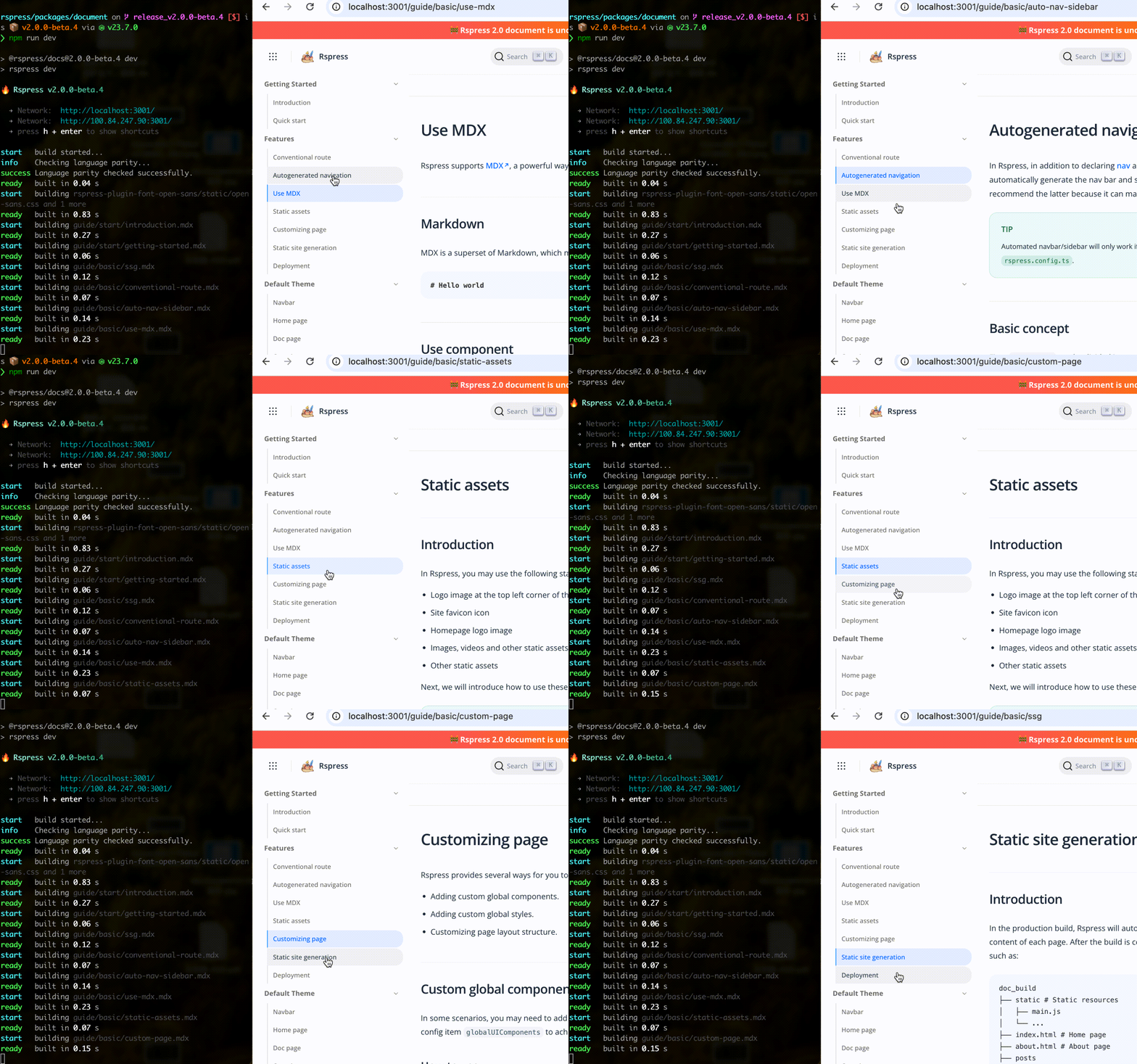
Persistent cache
2.0 also enables persistent cache by default, reusing previous compilation results during warm starts to improve build speed by 30%-60%. This means that once you've run rspress dev or rspress build in your project, subsequent rspress startups will be noticeably faster.
Documentation development experience
Dead link checking enabled by default
Rspress 2.0 enables dead link checking by default. During the build process, it automatically detects invalid links in documentation, helping you discover and fix issues promptly.
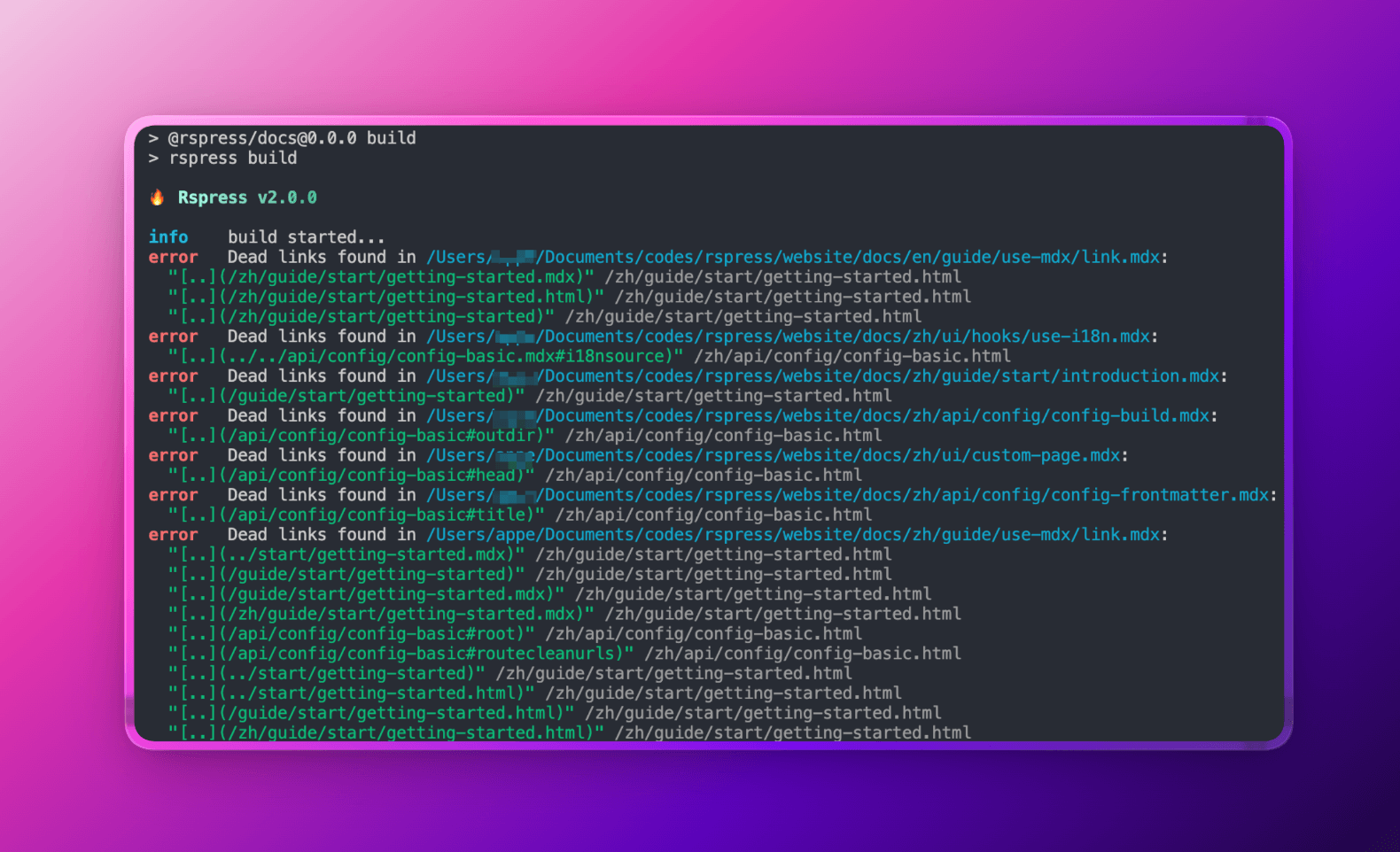
See Links for details
File code blocks
You can use the file="./path/to/file" attribute to reference external files as code block content, maintaining example code in separate files.
See File Code Blocks for details
More flexible meta usage for preview
@rspress/plugin-preview is now based on meta attributes, making it more flexible and compatible with file code blocks.
Here is an example using iframe preview for a code block:
It will render as:
Additionally, @rspress/plugin-playground now supports being used together with plugin-preview, switching via meta attributes, e.g., ```tsx playground
HMR support for configuration files
Based on the redesigned virtual module plugin for Rsbuild, HMR is now supported for i18n.json, _nav.json, _meta.json, file code blocks, and iframe-related configurations in @rspress/plugin-preview. After modifying these configuration files, the page will automatically hot-reload without manual refresh.
Rslib & Rspress
When creating a project with create-rslib, you can now select the Rspress tool. This allows you to quickly set up a documentation site alongside your component library for writing usage guides, displaying API references, or live-previewing component effects.
Run npm create rslib@latest and select Rspress to generate the following file structure:
The template includes the rsbuild-plugin-workspace-dev plugin, which automatically runs Rslib's watch command alongside the Rspress development server.
Simply run npm run doc to start the Rspress development server and preview your Rslib component library:
More official Rspress plugins
Rspress 2.0 has added several official plugins:
- @rspress/plugin-algolia: Replace Rspress's built-in search with Algolia DocSearch (thanks to the @algolia team for their assistance).
- @rspress/plugin-twoslash: Add type hints to TypeScript code blocks.
- @rspress/plugin-llms: Provide llms.txt generation capability for projects that don't support SSG and SSG-MD.
- @rspress/plugin-sitemap: Automatically generate Sitemap files for SEO optimization.
Other breaking changes
Migrating from Rspress 1.x
If you are a 1.x user, we have prepared a detailed migration guide to help you upgrade from 1.x to 2.0.
You can use the "Copy Markdown" feature on the page and feed it to your preferred coding agent (such as Claude Code) to complete the migration.
Please refer to the Migration Guide.
Removal of mdxRs configuration
We noticed that a large portion of 1.x users were actively disabling mdxRs to use Shiki, component library preview features, and custom remark/rehype plugins. With lazyCompilation and persistent cache enabled, performance optimization is already quite significant even with the JS version of the MDX parser.
In exchange for better extensibility and maintainability, we decided to stop using the Rust-based MDX parser (@rspress/mdx-rs) in the Markdown/MDX compilation pipeline. This enables Rspress to better integrate tools from the JavaScript ecosystem like Shiki.
Node.js and upstream dependency version requirements
Rspress 2.0 requires Node.js version 20+ and React version 18+.
Package name and import path changes
Rspress has consolidated rspress, @rspress/runtime, @rspress/shared, and @rspress/theme-default into @rspress/core. Projects and plugins now only need to install a single @rspress/core package.
If you have developed an Rspress plugin, please change the plugin's peerDependencies from rspress to @rspress/core:
Next steps
The release of Rspress 2.0 is just a new beginning. After this release, Rspress will continue to iterate:
-
Advancing Ecosystem Integration: Deeper integration with Rslib and Rstest to provide an integrated development experience for frontend projects and component library projects.
-
Exploring Deeper AI and Documentation Integration: Such as intelligent Q&A, automatic summarization, and more; refining SSG-MD to make it stable and easier to use.
Thank you to all developers and users who have contributed to Rspress! If you encounter any issues or have suggestions during use, please provide feedback in GitHub Issues.
Upgrade to Rspress 2.0 now and experience a brand new documentation development journey!